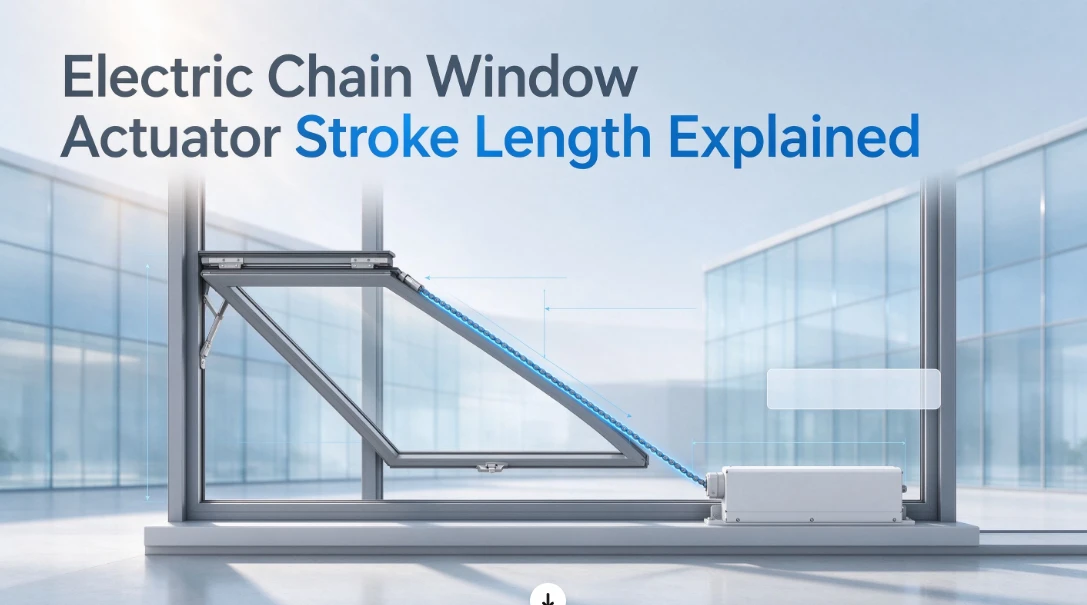
When you design an automatic smoke vent window system, you must specify the correct hardware to ensure optimal airflow and life safety. Facility managers and builders often focus heavily on the lifting force of the motor. However, understanding the stroke length of an electric chain window actuator remains equally crucial for your project success.
This guide explains the definition of the stroke, how it interacts with window geometry, and why getting this measurement right prevents costly mechanical failures.
What Is the Actuator Stroke?
The stroke length refers to the maximum linear distance the chain extends from the actuator housing. When you activate the electric chain window actuator, the internal motor pushes the chain outward to open the window sash. It represents the physical travel capacity of the drive mechanism.
Manufacturers always measure and mark this extension distance in millimeters (mm). You will commonly see industry-standard sizes like 300mm, 400mm, 600mm, or 800mm printed directly on the product specification label. Some advanced models offer adjustable strokes, allowing installers to set specific extension limits via electronic dip switches during installation.
Relationship Between Stroke and Opening Distance
The stroke length directly dictates how far the window sash travels from the main frame. However, a 400mm chain extension does not automatically equal a 400mm clear opening gap across the entire window. The final opening distance depends heavily on the hinge position and the overall geometry of the window sash.
For top-hung or bottom-hung windows, the chain pushes the opposite edge of the sash outward, creating a pivoting angle. The geometric free area changes based on this specific opening angle. A shorter window requires less stroke to achieve a wide angle, whereas a taller window requires a significantly longer stroke to reach that exact same opening angle.
Risks of Incorrect Stroke Selection
Selecting the wrong stroke length introduces severe operational risks to your building ventilation system. You must avoid these common specification errors:
- Insufficient Ventilation Area: Choosing a stroke that is too short prevents the window from opening fully. This restricts natural airflow and drastically reduces the geometric free area. In a fire emergency, a restricted opening fails to exhaust smoke efficiently, violating strict EN 12101-2 safety regulations.
- Mechanical Interference: If you select a stroke that exceeds the physical capacity of the window hinges, the actuator will force the sash past its limits. This mechanical interference causes bent aluminium frames, shattered glass, and completely snapped hinges.
- Premature Motor Failure: When a long stroke attempts to push a physically constrained window, the electric chain window actuator will stall. The motor will continuously draw high current trying to reach its full extension, which quickly burns out the internal electronic components.
How to Determine the Required Stroke Length
To specify the correct actuator, you must evaluate the window dimensions and your target ventilation requirements. Building codes often dictate the required geometric free area for smoke exhaust. You must translate that area requirement into a specific opening angle.
Once you know your required opening angle and the height of the window sash, you can calculate the exact stroke length using a standard trigonometric formula:
Stroke = 2 × Window Height × sin(Opening Angle ÷ 2)
If you want to avoid complex math, you can use standard industry estimates for hinged windows. Review this simplified reference table:
| Target Opening Angle | Required Stroke Length |
| 30 Degrees | 52% of Window Height |
| 45 Degrees | 76% of Window Height |
| 60 Degrees | 100% of Window Height |
Always verify your final calculations against the physical limits of your window profile. Ensure your hinges can safely accommodate the angle you intend to achieve before you mount the hardware.
Summary
Selecting the proper electric chain window actuator stroke guarantees that your automatic smoke vent windows operate safely and efficiently. Accurate stroke calculations maximize smoke exhaust rates, comply with commercial building standards, and protect your window frames from destructive mechanical interference.
FAQ
- What does the stroke length mean on an electric chain window actuator?
The stroke length indicates the maximum physical distance the internal chain extends out of the actuator housing to push the window open. Manufacturers measure this distance in millimeters. - Can I adjust the stroke length after purchasing the actuator?
You can adjust the stroke length on specific programmable or dip-switch enabled models. Standard fixed-stroke actuators do not allow adjustments and require you to purchase the exact size needed. - How do I calculate the stroke needed for my window?
You calculate the required stroke by multiplying your window height by two, and then multiplying that result by the sine of half your target opening angle. - Why is stroke length important for EN 12101-2 smoke vents?
The stroke length directly controls the geometric free area of the open window. You must specify an adequate stroke to ensure enough smoke escapes the building to meet EN 12101-2 certification standards. - What happens if the window actuator stroke is too long?
An excessively long stroke will push the window sash beyond its mechanical hinge limits. This causes severe mechanical interference, frame damage, and potential motor burnout.
Reference Sources
- Firgelli Automations: What Is an Actuator? Types, Uses & How It Works
- TiMOTION: Electric Window Actuators/Openers for Automation
- Teal Products: Ultimate Guide To Window Actuators Automation Natural Ventilation
- Yale: Intelligent Window Opening System
- WindowMaster: Guide to EN 12101-2 and FPC requirements
- kg-tectronic: Openings for smoke exhaust
Leave a Reply