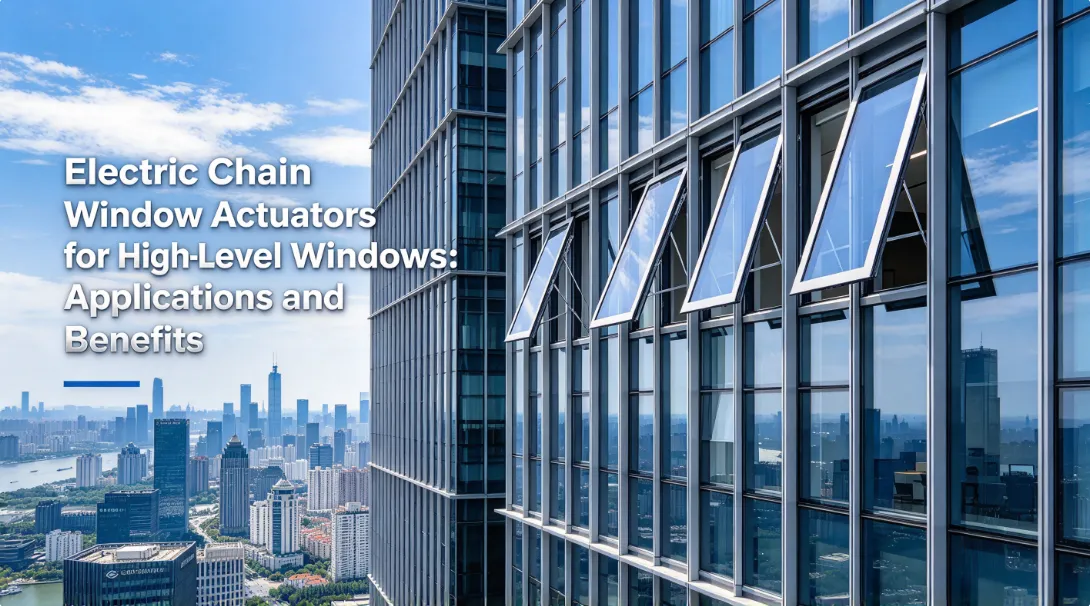
Modern building designs frequently feature high-level windows to maximize natural light and thermal efficiency. However, operating these hard-to-reach vents presents a significant facility management challenge. Facility managers cannot rely on manual extension poles for daily climate control or emergency smoke exhaust.
The electric chain window actuator provides a reliable, automated solution for operating high-level commercial windows. This guide explores the mechanical principles, core applications, and critical design factors you need to consider for natural ventilation and Automatic SWhat Is an Electric Chain Window Actuator?
How Electric Chain Window Actuators Works?
The actuator mounts directly to the window frame or sash. An electric motor drives a sprocket gear, which pushes the chain outward to open the window. To close the vent, the motor reverses direction and pulls the chain back into the housing.
Facility teams control these movements through various inputs. Users can operate them via simple wall switches, wireless remote controls, or automated building management systems. Integrating these actuators with environmental sensors allows the system to function completely autonomously.
The Benefits of Automating High-Level Windows
Building operators face multiple difficulties when managing high-level ventilation manually. Automating these vents delivers immediate operational and safety advantages.
- Solves Manual Operation Difficulties: High windows sit well beyond human reach, making manual hand cranks impractical and time-consuming for large facilities.
- Enables Centralized Control: Modern facilities require synchronized window operations to flush indoor air efficiently across different zones at the push of a button.
- Improves Daily Ventilation Management: Proper indoor air quality requires frequent adjustments based on weather changes, which manual operation simply cannot accommodate.
Key Applications in Modern Buildings
Different facilities leverage an electric chain window actuator to solve distinct operational challenges.
- Educational Facilities: Schools use these systems to maintain fresh air circulation in classrooms and gymnasiums. Automated windows connect to CO2 sensors to improve air quality and student concentration.
- Commercial Office Buildings: Office designs integrate high-level vents to promote cross-ventilation. This natural cooling method reduces reliance on HVAC systems and lowers overall energy consumption.
- Industrial Plants: Factories generate immense heat and airborne pollutants. Automated roof vents release industrial exhaust efficiently while closing rapidly during sudden rainstorms.
- Large Public Buildings: Auditoriums require massive air displacement. Actuators connect to climate control systems to regulate temperatures across vast open spaces.
Essential Design and Selection Considerations
Selecting the correct actuator requires careful evaluation of the window mechanics and building safety codes.
- Window Type and Installation Space
Your actuator must match the specific window mechanism. Top-hung, bottom-hung, and parallel-opening windows require different bracket designs. Chain actuators offer a low-profile casing, making them ideal for tight installation spaces on curtain walls where standard drives would protrude.
- Actuator Thrust and Stroke Length
Engineers must calculate the precise push/pull force required to move the sash. This calculation depends on the window’s weight, dimensions, and opening angle. The stroke length determines how far the window opens, directly impacting natural ventilation rates and smoke exhaust volume.
- Control Methods and Voltage
Facility planners must choose the appropriate control architecture for their specific needs.
- 230V AC Systems: These suit everyday natural ventilation needs where users control windows via simple wall switches.
- 24V DC Systems: Fire safety regulations mandate 24V DC actuators for Automatic Smoke Vent Windows. These units run on battery backups during power failures.
Summary
Integrating an electric chain window actuator into high-level window designs eliminates the limitations of manual operation. These motorized systems provide crucial natural ventilation and ensure life-saving smoke exhaust capabilities. By evaluating window weight, required stroke, and control systems, architects can select the optimal automation solution for any building.
FAQ
What is an electric chain window actuator used for?
It automates the opening and closing of hard-to-reach windows in commercial and public buildings. It provides daily natural ventilation and emergency smoke exhaust without requiring manual intervention.
Can electric window actuators operate during a power outage?
Yes, when configured for life safety. Actuators used for Automatic Smoke Vent Windows typically operate on 24V DC power connected to a fire control panel equipped with a battery backup system.
How do you determine the correct actuator thrust?
You must calculate the thrust based on the window’s total weight, its dimensions, and the specific hinge type. Heavy roof skylights require significantly more push force than standard vertical side-hung windows.
Are chain actuators suitable for all window types?
Chain actuators work exceptionally well for top-hung, bottom-hung, and awning windows. However, heavy industrial skylights might require heavy-duty linear spindle actuators for maximum stability.
How do rain sensors work with window automation?
Smart control systems monitor real-time weather conditions. When the exterior sensor detects rain or high wind speeds, it sends an immediate signal to the actuators to close the windows, preventing indoor water damage.
Reference Sources
- Types of Electric Chain Window Actuators and Their Applications | PRE WELL
- Automated windows for ventilation in school buildings | GEZE
- Electric Window Actuator Case Study: School Auditorium Ventilation in Santo Domingo | PRE WELL
- Electric Chain Window Actuator Stroke Length Explained | PRE WELL
Leave a Reply