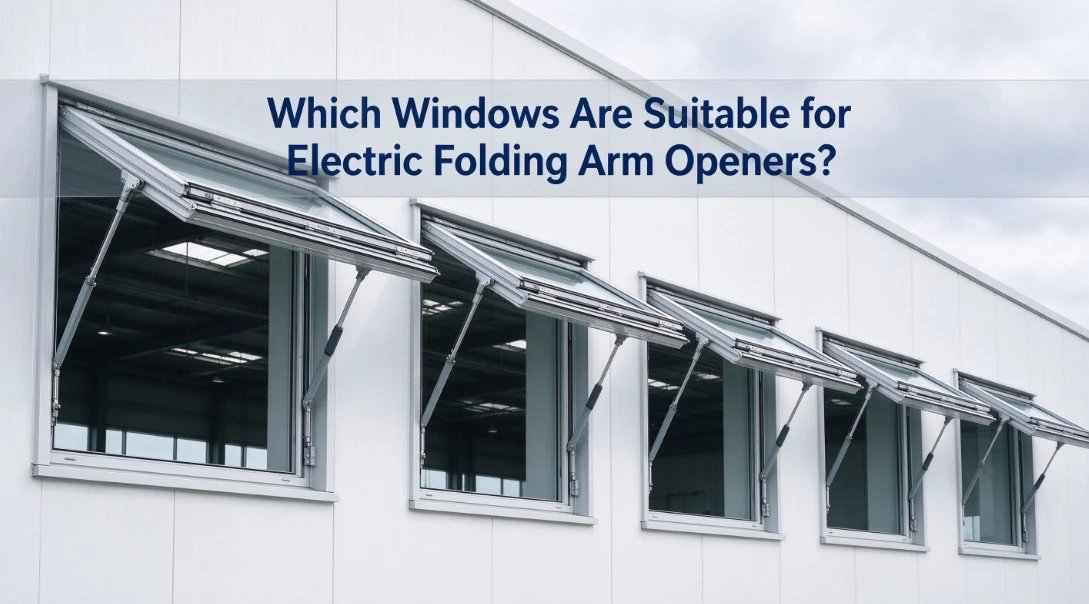
Choosing the correct mechanism for automatic smoke vent windows determines the efficiency and safety of a building. Installers often debate which hardware suits specific window frames. You must evaluate the mechanical geometry of the opening before making a final decision.
Understanding Actuator Mechanisms in Smoke Vents
The fundamental motion of the hardware dictates its compatibility. An electric chain window actuator pushes a rigid chain straight outward. In contrast, a folding arm opener relies on an articulated metal joint that swings in an arc. This swinging motion requires specific physical conditions to function correctly.
If you ignore how the actuator moves in three-dimensional space, you risk damaging both the motor and the window frame during operation.
4 Key Factors That Dictate Compatibility
To determine if a folding arm fits your architectural design, evaluate these four mechanical variables:
- Window Sash Trajectory: The arc of the folding arm must perfectly align with the natural pivot path of the hinges. If the trajectories clash, the motor will bind.
- Bracket Placement: You need robust, reinforced profile sections on both the sash and the frame to anchor the heavy-duty brackets.
- Installation Space: Articulated arms need significant lateral clearance to unfold. Tight corners or deep window reveals often block the motion.
- Opening Angle: Folding arms excel at pushing vents to a full 90-degree angle, making them vital for maximum aerodynamic free area in smoke control systems.
Highly Compatible Window Types for Folding Arms
Side-Hung Outward Opening Windows (Casement Vents)
Folding arms perform best on side-hung casement windows. Because these windows open like doors, the sweeping motion of the articulated arm easily pushes the sash outward. Automatic Opening Vent (AOV) systems often use this setup to achieve a full 90-degree opening.
The folding arm provides the high torque and structural stability necessary to hold wide angles against heavy wind loads. This makes it an ideal choice for facade doors and large corridor vents.
Side-Hung Inward Opening Windows
You can also use folding arms on inward-opening side-hung vents. However, this application demands specialized inward-opening bracket kits. The installer mounts the motor on the frame while the arm pulls the sash inward.
You must ensure the interior room has enough clearance to accommodate the intruding sash and the extended arm geometry. If space is limited, the mechanism will hit interior walls.
Evaluating Specific Top-Hung and Other Windows
Specific Top-Hung Windows
Standard top-hung windows present a challenge for folding arm openers. The weight distribution and vertical lifting path do not naturally suit a swinging arm. For most standard top-hung vents, engineers prefer an electric chain window actuator due to its linear pushing force and compact profile.
However, you can use folding arms on heavy, specialized top-hung windows if you require a massive opening angle. This setup requires heavy-duty sliding brackets that allow the arm’s pivot point to travel along the sash profile as the window pushes upward.
Roof Windows and Skylights
Installers rarely use folding arms on flat roof skylights. The dead weight of horizontal glass requires direct vertical lifting power. Linear spindle actuators provide better upward thrust for these specific smoke exhaust applications.
Why You Cannot Judge Compatibility by Appearance Alone
Many building owners look at a window and assume any motor will fit. You must avoid this visual trap. Two identical-looking windows might have entirely different internal profile depths or hinge configurations.
Friction hinges shift the pivot point as the window opens. A standard folding arm expects a fixed pivot point, like a butt hinge. If you pair a fixed-arc arm with a shifting-pivot friction hinge, the mechanical conflict will snap the bracket or burn out the motor.
Always calculate the exact frame depth, hinge travel path, and bracket clearance before buying equipment. Relying solely on the exterior appearance of the window will lead to costly installation failures.
Actuator Comparison Table
| Feature | Folding Arm Opener | Electric Chain Window Actuator |
| Primary Motion | Articulated swinging arc | Linear chain extension |
| Best Window Type | Side-hung (casement), large doors | Top-hung, bottom-hung, roof vents |
| Max Opening Angle | 90 degrees | Standard 300mm to 800mm stroke |
| Space Required | High lateral clearance needed | Minimal, highly compact profile |
| AOV Suitability | Excellent for maximum free area | Excellent for standard smoke venting |
FAQ
- Can a folding arm opener achieve a 90-degree opening?
Yes. Manufacturers design folding arm actuators specifically to push side-hung windows and doors to a full 90-degree angle to maximize the aerodynamic free area for smoke exhaust. - When should I choose an electric chain window actuator over a folding arm?
You should choose a chain actuator for top-hung, bottom-hung, or smaller windows where installation space is tight and you only need a standard opening stroke. - Do outward opening windows require special brackets for folding arms?
Standard bracket kits usually accommodate outward-opening side-hung windows. However, inward-opening configurations always require specialized mounting brackets to manage the reverse pulling force. - What happens if the installation space is too narrow for a folding arm?
If the window reveal lacks lateral clearance, the folding arm will strike the wall before fully extending. You must switch to a linear or chain actuator that operates directly perpendicular to the frame. - Will a folding arm work with friction hinges?
Generally, no. Friction hinges alter the sash’s pivot point during operation, which conflicts with the fixed sweeping arc of a standard folding arm. You need butt hinges with a fixed pivot point for safe operation.
Reference Sources
WMD 820 – WindowMaster 24v Side Hung Folding Arm Actuator – Teal Products.
Casement Window Automation: Actuator Selection and Installation Considerations.
The Ultimate Guide to Window Actuators in 2025 – Group SCS.
Leave a Reply